A GALA CHRISTMAS – AND A BIG THANK YOU

We were delighted to welcome so many people to our Christmas concert last Saturday at St. Nicholas Sevenoaks. We had a uplifting evening singing carols from across the ages, from There is No Rose to a beautiful arrangement of My Heart Will Always Wander by the modern Norwegian composer Magnussen in its first UK performance. There were readings inspired by the Christmas story and some fantastic original accompaniments from the brass quintet Mardi Brass.  They also played a lovely, measured arrangement of the Symphony from the Messiah and a spirited and witty medley of more modern Christmas songs. With audience carols and the rousing backdrop of the organ played by Riccardo Bonci we hope our audience had as enjoyable evening as we did.

On Tuesday before our concert we sang carols at Sevenoaks Station for the Red Cross Ebola appeal. We thank our friends and family who helped us with the collection as we sang. We raised over £350. We continued our collection after the concert itself and were able to contribute in total to the fund just over £1000 which was a fantastic achievement. Thank you to everyone for your support.

Music for a Summer Evening – Programme Notes

7.00pm, Saturday 14 June – St Martin’s Church, Brasted
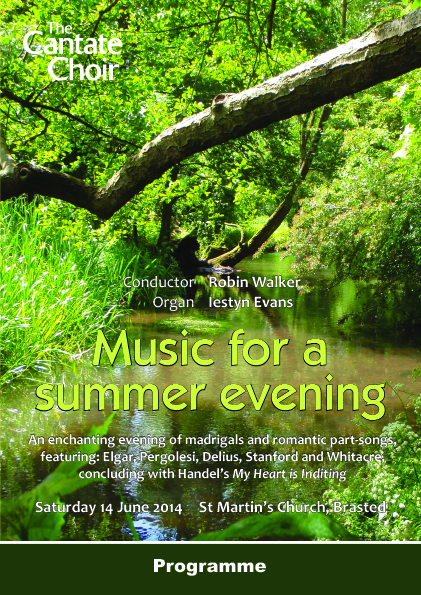
Front cover

Soloists

Robin WalkerConductor
Iestyn EvansOrgan

Programme

T. Campion 1557—1620 – Never weather-beaten sail
J. Bartlet fl. 1606—10 – Of all the birds that I do know
R. Jones fl. 1597—1615 – Farewell, dear love
G. Finzi 1901—56 – My spirit sang all day
E. Elgar 1857—1934 – As torrents in summer
C.H.H. Parry 1848—1918 – Music, when soft voices die
C.V. Stanford 1852—1924 – The blue bird
F. Delius 1862—1934 – To be sung of a summer night on the water (two unaccompanied part-songs)
G.B. Pergolesi 1710—1736 – Magnificat
A. Hollins 1865—1942 – A Trumpet Minuet
J. Jongen 1873—1953 – Petite Prélude
M. Lanquetuit 1894—1985 – Toccata
Eric Whitaker b. 1970 – Sleep
G.F. Handel 1685—1759 – My heart is inditing

Programme notes

Music, when soft voices die, vibrates in the memory Percy Bysshe Shelley

The theme of this poem, set to music by Parry among several others, is the ability of sounds, sights, smells and emotions to linger and be stirred in the memory long after the fact. In some ways a thread of memories is stirred by tonight’s programme but it is an uncertain and discontinuous one. It is a trail which we now lose and then rediscover in another place and another time.

The first half may be said to encompass two periods of English Renaissance, the first in the 16th and 17th century with the flowering of madrigals, ayres and anthems and the second in the late 19th and early 20th centuries, when composers stepped once more into the light of European recognition. England under Elizabeth I and James I provided a period of peace and encouragement for the arts. In a list of 67 composers from this time, 24 of them are names you will probably know or who made pieces you would recognise if you heard them. Then the land fell largely silent.

In 1904, the German critic Oskar Schmitz described Britain as a ‘land without music’. However, there was already a revival afoot in music making at all levels. There was huge growth in amateur and professional choirs and orchestras and we remain unsurpassed in our national quality of performance to this day. The Royal College of Music was expressly set up ‘to rival the Germans’ and produced the leaders of this new movement in Parry and Stanford. What they started, the likes of Elgar, Finzi, Vaughan Williams, Holst, Walton and even Delius continued. ‘Fritz’ Delius was considered too German to count but ironically it is his music which captures the idyllic English countryside and lazy summer days better than anyone’s.

In the first English Renaissance, you could argue that the poetry was not great but the musical settings often were. Do we remember George Gascoigne, the poet Thomas Campion or anon.? Unlikely! The words are often obscure and susceptible to erotic interpretation as with John Bartlet’s Philip the sparrow, who cries yet, yet, yet, yet…..! By the time of the second Renaissance, English Literature is a major world subject with a long unbroken tradition. Parry and Stanford moved in the same circles as Robert Bridges, Mary Coleridge, Robert and Elizabeth Barrett Browning, Christina Rossetti and Alfred Lord Tennyson.

Tackling their poetry must have been both privileged and intimidating. Later generations of composers like Finzi and Delius had some latent memory for word setting built into their DNA, which makes their songs generally more fluid and natural. ‘My spirit sang all day’ is No.3 of Finzi’s Seven Poems by Robert Bridges. It captures the emotional arc of the lover’s joy in just 44 bars of sublime music. ‘The Blue Bird’ is a setting by Stanford of a Mary Coleridge poem. She was grand-niece to Samuel Taylor Coleridge and her father Arthur Duke Coleridge founded the London Bach Choir with Jenny Lind in 1875. Robert Bridges, the Poet Laureate, described her poems as ‘wondrously beautiful… but mystical rather and enigmatic’. Stanford’s setting still seems experimental today and hard to pull off but it paints the most wonderful image of summer blue all around you.

For the second half of our concert, we step in from the fertile territory of our green and pleasant land – quite literally if weather has permitted the first half to be outdoors. We have already seen that pupils will usually surpass their teachers but it comes to something when a pupil passes off his teacher’s piece as his own. Well, in fairness, it was not Pergolesi himself but a much more recent musicologist who wrongly ascribed Francisco Durante’s ‘Magnificat in Bb major’ to Pergolesi and the myth persists despite most scholars disagreeing. Whoever wrote it, it is typical of the School of Naples in the seventeenth century, where both men worked. Technically competent, it is an unsentimental setting of Mary’s song of gratitude, once she has come to terms with being single, pregnant, poor and homeless. She realizes that she has effectively been crowned the queen of heaven, mother of God, ‘from henceforth all generations shall call me blessed’.

Eric Whitacre is an American composer and something of a Gareth Malone of the internet. His choral pieces draw on the long back catalogue of English language word setting. They are understated, direct, yet with a personal voice. What he does with his pieces is to use cutting-edge technology to bring ordinary people together from around the world in performance. Do visit his website www.ericwhitacre.com and experience his virtual choir performances of ‘Sleep’ and other works or listen to him on the global TED website (www.ted.com), which brings ideas together from Technology, Entertainment and Design.

This piece started out as a setting of Robert Frost’s poem ‘Stopping by Woods on a Snowy Evening’ but copyright issues meant he could not use the words so he asked a friend to write new lyrics and, personally, I think they are better.

And so we come to the one strong voice in the Land without Music, which sang out between one renaissance and the next and, blow me down, he was German and this piece was written for the coronation of a German! Of course, another strong theme for this land of ours is to welcome immigrants and adopt them as our own. It is therefore entirely fitting for Handel to take words set by Purcell at the Coronation of James II in 1685 (the year of Handel’s birth but that is nothing to do with anything) and use them for his own setting at the Coronation of George II in 1727. ‘My heart is inditing’ is the fourth Coronation Anthem and the last in the ceremony when the queen is crowned, in this case Charlotte. The words from Psalm 45 and Isaiah 49 extol the virtues and rank of women. ‘Kings’ daughters were among thy honourable women’ and the queen is as ‘a nursing mother’ to the nation. The Cantate Choir sang Purcell’s version in June 2009 alongside Parry’s Songs of Farewell, settings of English poets including Thomas Campion….. ah, there go those vibrations again!

Sara Kemsley

Linsay Martin

Linsay read for the choir during its A Gala Christmas concert in December 2014

LinsayMartin300W

Linsay trained at Aberystwyth University, earning a joint honours B.A. in English and Drama. She has participated in many amateur and semi-professional productions: plays, musicals, operas, cabarets and reviews. Highlights include Nellie Forbush in ‘South Pacific’, both Joyce Harper and Miss Gossage in different productions of ‘The Happiest Days of Your Life’ and Third Priest in ‘Jesus Christ Superstar’ – a professional production which she also choreographed (and understudied Caiaphas and Herod!). Linsay worked as a theatrical dresser and (briefly) wardrobe mistress at the Yvonne Arnaud Theatre in Guildford.

Linsay has also worked in television as a Producer’s Assistant at Euston Films (productions including ‘Capital City’, ‘Selling Hitler’ and ‘Anglo-Saxon Attitudes’), P.A. to the Controller of Drama at London Weekend Television and a Drama Script Editor at the BBC (‘Silent Witness’ series 2 and ‘The Hello Girls’). She re-trained after having her two children and is now a primary school teacher who dabbles in voice-over work, when the opportunity arises.

Lawrence Thornbury

Lawrence read for the choir during its A Gala Christmas concert in December 2014

LawrenceThornbury300W

Lawrence trained at Guildford School of Acting graduating in 1983. While working in Theatre and television, he was offered a job at Tonbridge School in 1989 as an Actor in Residence and this was to be the start of his longest run.

He continued to work as an Actor for the first few years whilst visiting Tonbridge to work with pupils and staff on a wide range of projects ranging from House Plays, GCSE and A Level performance work as well as major school productions. Eventually, having been asked to join the school as Head of Drama, Lawrence settled into the role of a school master and has been at Tonbridge ever since.

Theatre work includes: John Bull, Bristol Old Vic; Candida, Redgrave Theatre Farnham; Hay Fever, Yvonne Arnaud Theatre Guildford; Oklahoma!, Yvonne Arnaud Theatre Guildford; Married Love, Wyndhams Theatre West End.

Television includes: Selling Hitler, ITV; The Camomile Lawn, C4; Kavanagh QC, ITV. Voice over work includes Dick and Dom Diddy Movies! and The Slammer both for CBBC.

A Gala Christmas – Programme Notes

7.30pm, Saturday 13 December – St Nicholas Church, Sevenoaks

A Gala Christmas concert poster

Soloists

Robin WalkerConductor
Mardi BrassBrass quintet
Riccardo BonciOrgan
Linsay MartinReader
Lawrence ThornburyReader

Programme

Carol arr. Robin Walker – Once in Royal David’s city
Reading John Milton – The Invocation from Paradise Lost
Choir Boris Ord – Adam lay ybounden
Carol arr. David Willcocks – Of the Father’s heart begotten
Reading Rainer Mari Rilke – Annunciation to Mary translated by Mary Dows Herter Norton
Choir Villette – Hymne à la Vierge
Carol John Goss, arr. David Willcocks – See amid the winter’s snow
Reading Henry Vaughan – Christ’s Nativity
Choir Praetorius – In dulci jubilo
Choir A. Pärt – Bogoroditse dyevo
Carol, adapted by Arthuer Sullivan – It came upon the midnight clear
Reading Sidney Godolphin – Hymn
Brass solo G.F. Handel – Symphony from Messiah
Choir Anon (ed. Stevens) – There is no rose - 15th C.
Carol arr. Mardi Brass – O little town of Bethlehem
Choir F. Mendelssohn – Rejoice and be glad all ye nations
Choir arr. Poston – The Boar’s head carol
Carol arr. Mardi Brass – Ding dong merrily on high
Reading John Betjeman – Christmas
Choir arr. Mardi Brass – God rest ye merry gentlemen
Choir arr. J. Magnussen – My heart will always wander trad. Norwegian
Carol arr. Mardi Brass – Silent night
Reading Ted Hughes – Minstral’s Song
Choir arr. Mardi Brass – The First nowell
Reading T.S. Elliot – The Cultivation of Christmas Trees
Brass solo – Let it Blow
Carol arr. Mardi Brass – Hark the Herald

Programme notes

Though wise men better know the way, It seems no honest heart can stray.” Sidney Godolphin, Hymn

I find it endlessly fascinating how differently people respond to Christmastide. You have the ‘it’s just for the children’ brigade who love all the presents and games but don’t like to admit it. There’s the ‘Bah! Humbug!’ fraternity who, like Scrooge himself, love it really when they get involved. Then there are the crusading spirits who like nothing better than to spend the time in a soup kitchen or the superior thinkers who pontificate on the true meaning of Christmas, while nipping at their port and mince pie. And let’s not forget the (British?) view that it does not really matter as long as it snows!

Sidney, Lord Godolphin wrote his Hymn in the 17th century. He was a Royalist MP for Helston in Cornwall at the time of the Civil War. His response, his Hymn, is an intelligent discussion of how the Wise Men, despite their knowledge and wealth, needed the input of the shepherds, the poor, ignorant working people, to find their way to the manger. The message is surely clear and as pertinent today as it was then and indeed two centuries ago, when Roman rule kept the poor firmly under the military and administrative boot. He suggests that, providing your heart and your intentions are sincere, then you cannot go far wrong.

So it is our intention to represent the many and varied responses to the Christmas season through our music and readings. We have the medievalism of Adam lay y-bounden to start the inevitable, pre-ordained journey from the Garden of Eden to the Crucifixion and the modernism of Arvo Pärt, whose 1990 hymn, Bogoróditse Djévo (Mother of God and Virgin), leans heavily on ancient Russian Orthodox chanting.

We have the scholarly and very French understatement of the Hymne à la Vierge by Pierre Villette. He was born in 1926 and studied with Maurice Duruflé. They shared influences from medieval music through to the melodic worlds of Fauré and Debussy. Contrast with this the far-from-erudite ‘Boar’s Head Carol’, which, despite the attempt to impress us with Latin phrases, is essentially an endorsement of the ‘eat and drink more than is good for you’ rule of Christmastide.

Michael Praetorius was a German composer and musicologist active in the early 17th century. From 1605 to 1610, he edited Musae Sioniae, a collection of 1244 arrangements of songs and hymns in nine volumes. You might assume that ‘In dulci jubilo’ from Part II would be a rather serious affair but in fact it is a dancing, imitative setting of the traditional tune with some additional harmonisations for brass by J S Bach. Our preconceptions about T S Eliot as an imposing, somewhat impenetrable poet (The only “method,” Eliot once wrote, is “to be very intelligent.”) are also confounded in his poem ‘The Cultivation of Christmas Trees’. He wrote this as a contribution to a literary project wherein very illustrious writers contributed holiday-themed works to a collection published in Britain in 1927. He wishes that we hang on throughout our lives to the sense of wonder that the young child has at the sights and smells of Christmas. He cites St Lucy, whose day on December 13th is widely observed in Nordic countries.

A young girl with crown of flaming candles is processed through the town. It is a time for eating, drinking and giving of gifts and is the Christian version of Yol or Yule, which marked the winter solstice.

The traditional carols, which we invite the audience to sing with us, are definitely given a dusting of snow, courtesy of the Mardi Brass arrangements. These are skilfully and wittily put together by Edward Maxwell (trumpet) and Adam Wolff (trombone). They are published under the title ‘Hark’ by Mardi Brass Publishing and we are grateful to the group for the use of them tonight. “Let it Blow” is a humorous romp through modern American Christmas songs in a medley arranged by Richard Hammond, not as far as I know a mad driver, but sometime trumpeter with Mardi Brass. I apologise to Superior Thinkers for the use of the word medley but that is what it is and this is another essential Christmas element, which can cover any facet of the season. According to the BBC Good Food guide you should make a ‘honey-mustard steamed green vegetable medley’ for Christmas but this is just posh sprouts to the Crusading Spirits. Or my favourite: Chocolate-covered fruit medley from Dilettante.com. ‘Chocolate is high in antioxidants and … include dried fruits that are also high in antioxidants.’ Healthy? No! It is just more of the ‘eat and drink more than is good for you’ rule. And what’s more, 36oz is not ‘perfect size for parties or get togethers’, it is a portion for one!

Yes, I do sit firmly with the ‘Bah! Humbug!’ fraternity but I still love the music of Christmas, be it the simplicity of ‘There is no rose of such virtue’ in this medieval setting or the full-throated Christmas motet ‘Rejoice and be glad’ by Felix Mendelssohn. There is something heartening in midwinter to revisit these ideas and revelations every year and to perform them and enjoy them with an honest heart. I am with T S Eliot on this one and sincerely hope that I can still marvel if only at the music of the season when I am eighty.

Sara Kemsley

Coffee Concert in Canterbury

In the photos below, you can see us rehearsing ready for our concert in October at the Canterbury Festival. We had a great time performing in the exotic Spiegeltent – a marquee set up at the Kent Cricket ground providing a very interesting, though at times challenging, venue for our concert.

With a setting feeling like something out of the Manet painting, Bar at the Folies-Begere, or maybe a Viennese Kafehaus, the glass and mirrors together with the burgundy awnings made the place very atmospheric, but, as might be expected, the acoustic was difficult.

However the concert was very well received and we enjoyed performing a range of different music, building on our winning programme for the Top Choir Kent finals which included Gabrieli’s Jubilate Deo and Over the Rainbow. To these we added some madrigals and folk songs and drew on favourites from our wide ranging repertoire including Standford and Bruckner as well as  jazz songs like Tea for Two. All in all a memorable occasion. Our thanks go to all those who made the trek to Canterbury to support us!

Rehearsing for the Spiegeltent at the Canterbury Festival

We are currently rehearsing for our next concert on the 25th October at 11 am at the Spiegeltent as part of the Canterbury Festival, Following the choir’s success at the Top Choir Kent competition last year we are honoured to be performing at the festival this year. Our one hour programme will feature some of our favourite folk songs, madrigals, classics and jazz pieces.

Canterbury Festival logo

Why not start your weekend with us and make a day of it at the festival, there is plenty going on throughout the day:  Accompanied walks (these are popular so worth booking now), comedy performance by Simon Evans, an evening concert by acclaimed choral group ‘Voces 8’ in Canterbury cathedral, performance artists  Finding the Silence and much more. Check out canterburyfestival.co.uk for details of programme and box office.

The Spiegeltent is a unique location – part baroque ballroom part exotic marquee – fantastic for an intimate and exciting concert . The Spitfire ground is a 2 minute drive or 10 minute walk from the centre of town, postcode CT1 3NZ . Tickets are only £5 from the festival box office and will be available on the door. It would be great to see some familiar faces in the audience, you will not be disappointed.

Spiegeltent

Wow, we won Top Choir Kent!

Top Choir Kent logo

The Cantate Choir performed at the finals of Top Choir Kent in Canterbury last night – 12th April 2014.  We had a fantastic time, enjoying the music from all the other wonderful and high quality competitors, and from the guests for the evening – the P&O choir – winners of the BBC programme Sing While you Work.  Music ranged from William Byrd to Coldplay, with many different styles and moods in between, and we were impressed by how smoothly the whole event went, providing as it did a great opportunity to raise money for charity.

Our own performances of Gabrieli, Somewhere over the Rainbow and Bobby Shaftoe we felt went well – a ‘demanding’ repertoire was the comment from the judges but, as they said, we were fully up to doing it justice.

Then that heart-stopping moment as they announced we were the winners! We were able to provide the grand finale with one last ringing rendition of Jubilate Deo.

We now will have the opportunity to perform as part of the Canterbury Festival in the Autumn and as part of the BBC Radio Kent Carol service at Rochester Cathedral.

If you weren’t able to make it or if you would like to relive the whole experience you can tune into BBC Radio Kent at 6 on Easter Morning (or follow up on iplayer for the following seven days at a more leisurely time!)

http://www.topchoirkent.org/

Photos taken at the Final of Top Choir Kent 2014. © Guy Gardener and the Rotary Club of Canterbury (all apart from trophy and certificate photo)

Latest concert breaks our box office record!

On Saturday March 22nd we performed our concert Spem in Alium. This turned out to be record breaking concert – the audience was the largest we have ever had, attracted no doubt by the wonderful music of Thomas Tallis as well as by His Majestys Sagbutts and Cornetts with whom we collaborated to bring this concert together.

The box office success was not the only record: for the first time we performed in 40 parts; to do this we invited additional friends to come along and augment our choir for the performance of Spem in Alium and His Majestys Sagbutts and Cornetts also took some of the parts – a common feature of Renaissance performance as the Cornett, a wooden wind instrument, was held to be the closest in sound to the human voice.

The rest of the programme provided a wonderful range of music from the Southern and Northern Renaissance with pieces of great poignancy combined with those of joyous celebration. Our conductor Robin Walker, as always, designed a varied and exciting programme, combining well-loved pieces with those less well-known – helping us to discover beautiful new repertoire.

His Majestys Sagbutts and Cornetts played a series of pieces that displayed the subtlety and range of their instruments to great effect, from fantastically rich chromatic music to with lively dances and stately suites. This leads us to yet another record as one of the pieces  was a newly edited work by Guami – and quite possibly had not been performed in public for at least 400 years before our concert!

Audience members commented on the thrilling range of music as well as the quality of the performances while the Spem in Alium mesmerised many. It was remarked that having the choir ranged round in a huge arc meant that the experience was entirely different from hearing a recording and the resulting surround sound was tremendous. We too were blown away by the standing ovation at the end!

Thank you especially to our friend Her Majestys Sagbutts and Cornetts. We had a wonderful time with them.

Top Kent Choir finalists!

We are through to the Top Choir Kent 2014 finals! Our CD submission was reviewed and we are now through to join five other choirs from across Kent at the final which takes place in Canterbury in April. The event is run by the Canterbury Rotary Club and supported by Belmont Insurance, BBC Radio Kent and the Canterbury Festival. All finalists will have their CD performances played on BBC Radio Kent and opportunities for the winners to take part in a some exciting choral events. Top Choir Kent raises money to support various charities and last year was able to make donations totalling over £7000.

Tickets to attend the final performances sell fast, so get on to them straight away! Tickets now available to buy via the website. http://www.topchoirkent.org/ where you’ll find lots more information about the event.

Mardi Brass

Mardi Brass performed with the choir in their Christmas concert in December 2014

Mardi Brass, brass quintetMardi Brass is a versatile and dynamic brass quintet which performs music in a plethora of musical styles spanning six centuries. Since its founding in 1992, the group has performed throughout Britain, thrilling audiences with its blend of music and humour.

Mardi Brass has performed at the Edinburgh Fringe and made an appearance on BBC2’s Edinburgh Nights, playing for the Perrier Comedy Award presentation. Other broadcasts have included In Tune on BBC Radio 3, a cameo appearance on BBC1’s Panorama and numerous features on local radio stations. In 1993 Mardi Brass took part in ClassicFM’s first birthday celebrations. The group has performed at prestigious venues such as the Purcell Room on London’s South Bank and has undertaken several tours of Britain and the Channel Islands.

Fauré’s Requiem

7.30pm, Saturday 28th February 2015 – St. Mary’s Kippington, Sevenoaks

Poster for Faure Requiem concert in February 2015The choir performed this compelling Requiem together with a programme including mezzo soprano and baritone solos,  other choral works and an organ work by John Ellis as well as his choral piece, The Mass of the Grove.

Top Kent Choir, 2015

Top Choir Kent logo
Top Choir Kent logo

Saturday 28th March 2015, Canterbury

As winners of Top Kent Choir, 2014, we performed at a special celebration in March to mark five years of this competition which does so much to raise money for charity. We joined six other choirs, all past finalists or runners up, each performing a 15 minute repertoire in the Shirley Hall in Canterbury. The evening culminated in a special performance by all the choirs and audience together of a special arrangement of ‘Help’ – the song by the Beatles – to mark its fiftieth anniversary. The whole event celebrated live music and singing, and we were delighted to be able to take part. See photos of us performing by following this link.

A Gala Christmas

7.30pm, Saturday 13 December – St Nicholas Church, Sevenoaks

A Gala Christmas concert poster

Soloists

Robin WalkerConductor
Mardi BrassBrass quintet
Riccardo BonciOrgan
Linsay MartinReader
Lawrence ThornburyReader

Programme

Carol arr. Robin Walker – Once in Royal David’s city
Reading John Milton – The Invocation from Paradise Lost
Choir Boris Ord – Adam lay ybounden
Carol arr. David Willcocks – Of the Father’s heart begotten
Reading Rainer Mari Rilke – Annunciation to Mary translated by Mary Dows Herter Norton
Choir Villette – Hymne à la Vierge
Carol John Goss, arr. David Willcocks – See amid the winter’s snow
Reading Henry Vaughan – Christ’s Nativity
Choir Praetorius – In dulci jubilo
Choir A. Pärt – Bogoroditse dyevo
Carol, adapted by Arthur Sullivan – It came upon the midnight clear
Reading Sidney Godolphin – Hymn
Brass solo G.F. Handel – Symphony from Messiah
Choir Anon (ed. Stevens) – There is no rose - 15th C.
Carol arr. Mardi Brass – O little town of Bethlehem
Choir F. Mendelssohn – Rejoice and be glad all ye nations
Choir arr. Poston – The Boar’s head carol
Carol arr. Mardi Brass – Ding dong merrily on high
Reading John Betjeman – Christmas
Choir arr. Mardi Brass – God rest ye merry gentlemen
Choir arr. J. Magnussen – My heart will always wander trad. Norwegian
Carol arr. Mardi Brass – Silent night
Reading Ted Hughes – Minstral’s Song
Choir arr. Mardi Brass – The First nowell
Reading T.S. Elliot – The Cultivation of Christmas Trees
Brass soloLet it Blow
Carol arr. Mardi Brass – Hark the Herald

Programme notes

View programme notes